
 Left to right: Operator Jari Vesaluoma, Kari Salminen
and Pentti Tolonen in the pulp mill control center.
Left to right: Operator Jari Vesaluoma, Kari Salminen
and Pentti Tolonen in the pulp mill control center.

Pulp washing line control: The ultimate balancing act
Stora Enso’s Veitsiluoto mill sees much better stability across the
whole line and improved washing efficiency
Until recently, the
brown stock washing area has not been highly automated and its performance
not been optimized in any significant way. In many pulp mills the washers
are equipped with basic instrumentation and the individual control loops
are supervised by a DCS system. In most cases, the coordination of these
individual control loops is done manually by the operators. In any manual
operation the results vary with the individual, so the stability of the
whole operation suffers. The transition periods during fiber species and
production rate changes can be particularly troublesome.
Many mills
are now realizing that poor performance in the washing line can have a
significant impact on the stability of operation and the production costs
in other related processes pulping or recovery process. For instance, poor
washing of the pulp can result in higher bleaching chemical consumption.
Organic materials that are not washed out of the pulp are a lost source of
energy for the recovery boiler. On the other hand, if the filtrate liquor
is too dilute, evaporation costs will be higher. In some cases this may
result in a production bottleneck for the whole pulp mill. Also, if outlet
consistency is not regulated and becomes too high the washer operation may
be halted.
The operation of the brown stock washing operation is
therefore a delicate balancing act, with the operators trying to achieve
the best removal of soluble impurities, the highest possible outlet
consistency and the highest solids content in the dilute liquor sent to
the evaporation plant. But operating practices vary from operator to
operator and, in some mills, the wood species and production rates change
on a regular basis, thereby destabilizing the washing process. Because the
washing line is a sequential, countercurrent operation, the stability of
the whole line can be upset. It may take only a few minutes to
destabilize, but the recovery may take several hours.
To address
these issues Metso Automation has introduced a whole-line optimization
control called DNAwash, which controls first the individual washing units
and then balances the distribution of washing liquors and manages filtrate
tank levels throughout the entire line. Most importantly, this control
manages the washing operation through transitions between fiber species
and during the usual production rate changes. The benefits of improved
washing line control and optimization include:
- Optimized washer load distribution
- Consistent operation, no human errors
- Lower, more stable washing losses
- Steam savings in evaporation plant
- More even pulp quality
- Reduced bleaching chemical use
- Alleviation of bottlenecks and higher production rates
More pulp with the same equipment
To realize many of these goals, Stora Enso Fine Paper’s Veitsiluoto mill, in Kemi, Finland invested in Metso Automation’s DNAwash, implemented in their metsoDNA control system. The pulp mill produces approximately 350 000 tonnes per year of ECF bleached pulp for the integrated paper mill. Like many pulp mills the capacity has been increased significantly from its startup in 1977, and the demand on its capacity was being stretched ever further by recently completed or in-progress rebuilds of two of the mill’s paper machines.
Pentti Tolonen, Pulp Mill Production Superintendent, emphasizes the mill’s difficult task to produce more pulp with the same equipment in the washing line: “In the coming years we must produce 385 000 tonnes per year. This was a big challenge for the washing equipment, some of which dates back to 1977.” He explains that balancing the line, even with good, experienced operators was difficult, especially when fiber species changes are made every second or third day. “They had to balance it in their heads,” he says. The softwood fiber is produced at about 1110 tonnes per day, while the hardwood fiber runs at about 1400 tonnes per day. Kari Salminen, Operating Engineer, says that operators in different shifts handled the upsets in different ways and filtrate tank stability was a problem during the transitions. To alleviate these stability problems and to establish consistent operation, the DNAwash controls were implemented during 2003.
Multiple levels of control
Washing line optimization controls are divided into three different control levels as shown in Figure 1. The first level is washing unit control, which involves rotation speed control for drum washers or wash presses or filter screen movement control for atmospheric or pressure diffusions washers. The next level is whole washing line control by applying the right amount of wash water to a achieve consistency targets. The final level is dynamic adaptation, which determines the total washing line dilution factor control.
The optimization of the entire washing line includes control of the dilution factor and material balances throughout the washing line. The dilution factor in the whole washing line is optimized by dividing the washing load between the individual washers. Finally, the usage of washing water is optimized by dynamic adaptation so that the capacity of the evaporation plant is used effectively, without overloading it.
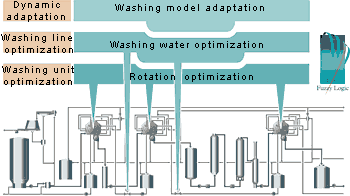
Figure 1: Hierarchy of optimization controls for a drum
displacement washer line
Diffusion model
defined
DNAwash employs a washing model, adapted to a specific
to a type of washer, to stabilize its operation and to achieve the highest
possible washing efficiency. The efficiency of the dilution and extraction
mechanism depends mainly on the consistencies to which pulp slurry is
initially diluted and finally thickened. The pulp slurry should be diluted
as much as possible and the pulp consistency after thickening should be as
high as possible. To enable longer retention times and thus a higher
degree of diffusion, the dilution and extraction process should be slowed
down as much as possible to remove solute absorbed within the pulp
fibers.
In brown stock a lot of absorbed solute, both organic and
inorganic, still remains, so the diffusion effect become vital in washing,
regardless of the mechanism. As a starting point for the optimum control
of a washing model has been developed to explain how soluble impurities
are removed from fibers by the diffusion process. This mass transfer model
is called Washing Potential in Diffusion. In simplified form, it is
expressed as a functional relationship.
Q= f (C, t, T)
Q= Washing Potential in Diffusion
C= Consistency
t= Time
T= Temperature
The washing
potential defines the capability of any washer to remove solute from the
fiber. This basic washing mechanism is used for controlling the washing
process in several different washing processes, all of which depend on
diffusion. The model is adapted for different fiber
species.
More stability, cleanest pulp
The control of
the washing line is customized to the individual line, its equipment,
capacities, process flows and dynamics. At the Veitsiluoto mill, the
process equipment consists of two parallel pressure diffusion washers
followed by a 1-stage atmospheric diffusion washer. A double drum filter
washer follows the knotting and screening operation. After the oxygen
delignification process, added in 1993, an atmospheric pressure diffusion
washer and a wash press complete the washing before the high density
storage chests. An overview of the controls in the line is shown in Figure
2. \2007\Pulp Paper Info\Pulp Washing_files\WTB-050314-2256F-5BB88_files\0(1).gif)
Figure 2: Overview of washing line control at Stora Enso
Veitsiluoto mill
In the pressure diffusers, the screen unit
is moved slightly faster than the pulp column movement. The washing model
sets the rate at about 1.1 times the pulp flow rate. This rate is
significantly slower than before the controls were implemented. Salminen
says, “The pressure diffusers now wash better. With the slower filter
basket movement more liquor is removed without plugging.” The atmospheric
diffuser screens are controlled in a similar way
In the higher level controls, outlet consistency is regulated by
wash liquor flow, at a level which avoids the risk of screen plugging. The
outlet consistency is calculated by mass balance with a measurement of the
blow line consistency, by means of a torque indication on the digester
outlet device.
The level of the pressure diffuser filtrate tank is
controlled by filtrate flow. The level of this filtrate tank, and others
in the line, is more precisely controlled by tank level predictors which
use a volumetric balance, knowing how much is entering and leaving the
tank. This more precise level control ensures a consistent supply of wash
water to previous stages, even during species changes. The same level
predictors are used to control the level of a large filtrate tank in the
screening department by regulating the wash water to the double drum
washer. The regulation of the washing water to this washer, and all other
washers in the line, ensures the dilution factor for the entire line is
controlled and filtrate flows are in balance, in order to maintain level
stability in the tanks. Further along, in the wash press, the feed
consistency is controlled to match its hydraulic water displacement
capacity. The rotation speed stabilizes the outlet
consistency.
Managing change, rebalancing the
line
When the fiber species change, hence production rate
changes, consistency and tank level targets are automatically adapted to
the new conditions. The dilution factor of the whole washing line is
controlled in the dynamic adaptation control level. The control
automatically tries to use as much washing water as possible in the
washing and therefore obtain the cleanest pulp. The control also
supervises the situation in the evaporation plant and ensures that weak
black liquor is not too dilute. The dynamic adaptation control adjusts the
flow of weak black liquor in the digester's by pass line.
Salminen
describes the benefits of this by-pass control: “It follows the needs in
the evaporation plant by looking at the tank levels. If there’s room then
more by-pass liquor is sent to the evaporators. Then more clean wash water
can be used in the wash press and we get better washing efficiency. The
optimization system always sends the maximum washing water to the wash
press. Here we get the best washing results. Then the rest of the line
balances. ”
The operators can follow the effectiveness of the
washing efficiency in each unit by referring to an information window
showing the conductivity of each filtrate as the pulp progresses though
the line. Low conductivities indicate better washing efficiency. Salminen
says the operators really make good use of this trend display; an 8-hour
history is the most popular.\2007\Pulp Paper Info\Pulp Washing_files\WTB-050314-2256F-5BB88_files\0(2).gif)
Figure 2: To see the washing effectiveness the operators can follow the filtrate conductivities throughout the line. They can select current values or those from 8 or 24 hours in the past
More consistency and maintaining it
Tolonen says the
whole line control has made its operation more consistent: “All the shifts
are now running the best way,” he says. This consistency has made the
washing operation more uniform and its main objective – producing a
consistently clean pulp- has been achieved. According to their statistics
Chemical Oxygen Demand (COD) to the bleach plant has been reduced by about
18% on softwood pulp and 32% on hardwood pulp. Bleach plant chemical
consumption is showing a downward trend and brightness deviations are
smaller. There are a number of reasons for this, including better washing
and a new wash press before the bleach plant.
The mill also
measures the success of the system by how consistently the operators use
the controls. In this respect, the controls have been a good success.
Salminen says the balancing of operations across the line is much better.
One person operates the pre-delignification washer and one person operates
the post-delignification washer. Their coordinated efforts are now more
effective.
These performance indicators – COD reduction and control
utilization – are now being used as benchmarks in a continuing Performance
Agreement signed with Metso Automation. In this partnership agreement,
specialists at Metso Automation regularly monitor the washing line
performance, using local people and also through a remote link to their
Pulp Centre in Tampere, Finland. With this high level of performance
monitoring and reporting Metso Automation and Stora Enso personnel have
become adept at solving problems and continually improving the process.
The mill sees a good return for the washing line process and others in the
mill. The Performance Agreement, in place since 1999, covers the major
unit operations in the pulping and recovery lines.
By Mark
Williamson, Freelance Writer, Thornhill, Ontario, Canada and Jari
Kapanen, Application Specialist, Pulp Mill Automation
Solutions, Metso Automation Inc.
Published with
permission of PPI, January 2005, p. 34-36.
 Print
Print Back
Back Top
Top